
Strata plan
Home / Strata Plan
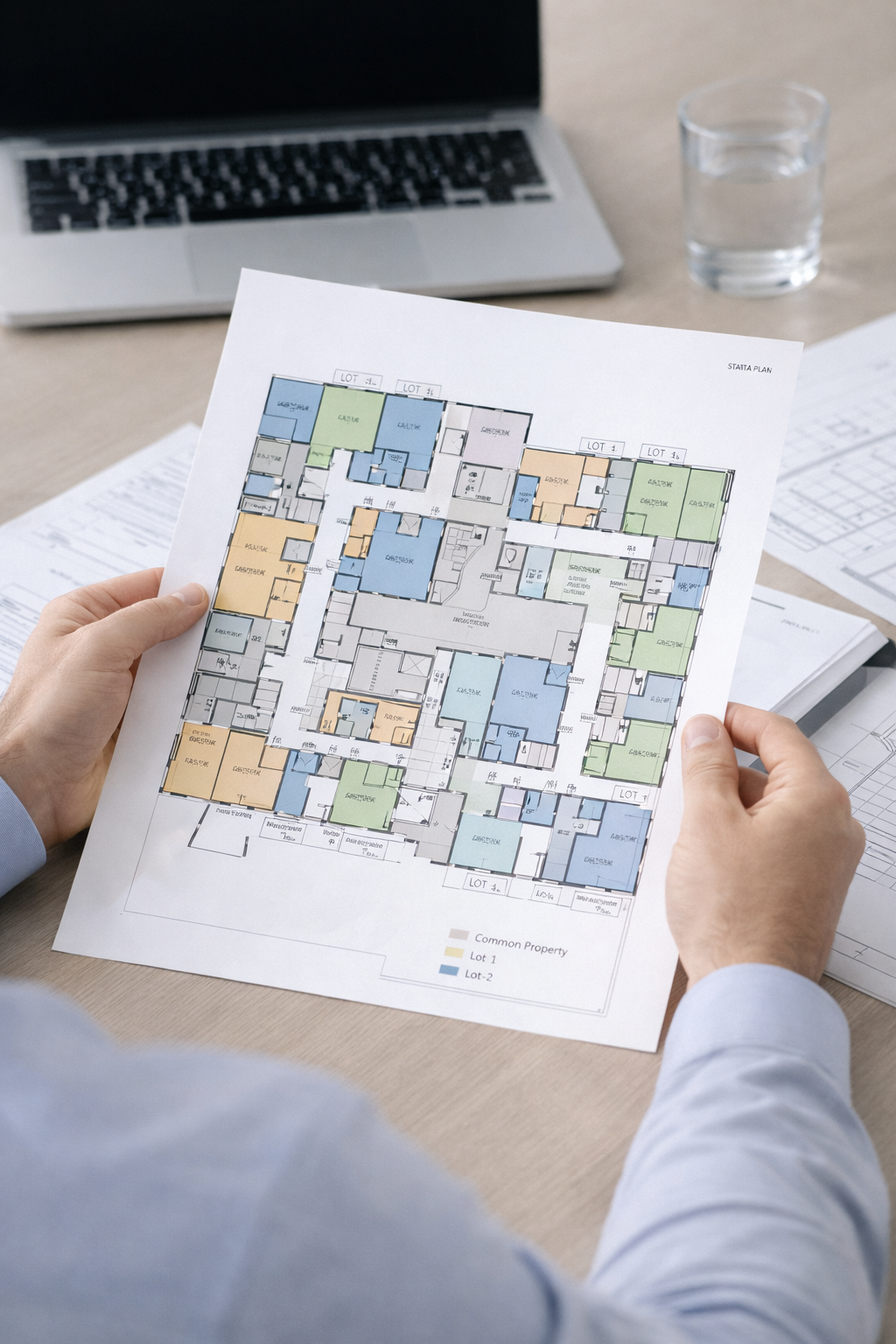
Strata Plan
A plan that is registered as a strata plan, and includes any information, certificate or other document required by this Act or the regulations to be included with the plan before it may be registered: s 4 Strata Schemes Development Act 2015 (NSW).
Successful Lawyer Firm
Understanding the Strata Plan
The strata plan is the foundation of every strata scheme. Under s 10(1) of the Strata Schemes Development Act 2015 (NSW), it must include the following:
- Location plan: outlines the land perimeter and the location of any building
erected on the land and of any lots not within the building. - Floor plan: identifies the position of each lot (or part lots) on each floor of the building.
- Administration sheet: a document in the approved form setting out administrative matters relating to the registration of plans.
- By-laws: the rules that regulate day-to-day living within the strata scheme
- Schedule of unit entitlement: lists the unit entitlement of each lot, which determines voting rights, levy proportions, and value for rating purposes.
Years of Experience
Successful strata cases
The Lot
Each lot consists of ‘one or more cubic spaces’ under s 4(1) of the Strata Schemes Development Act 2015 (NSW). The base of each cubic space is designated as a lot or part of a lot on the floor plan. Generally, where the cubic space (or spaces) comprising a lot is fully enclosed, the boundaries of the lot are the inner surface of the walls, the upper surface of the floor, and the under surface of the ceiling (s 6(1)(a) of the Strata Schemes Development Act 2015 (NSW)). These boundaries are defined by the condition of those surfaces at the date of registration of the strata plan.
Internal walls dividing the cubic space into separate rooms are part of the lot rather than common property, as they are wholly within its boundaries (Burgchard v Holroyd Municipal Council [1984] 2 NSWLR 164; LDJ Investments Pty Ltd v Howard (1981) 3 BPR 9614; Symes v Proprietors SP 31731 [2001] NSWSC 527 at [26]).
By-laws
By-laws are the key governance mechanism of strata schemes, regulating most aspects of daily living. The power extends to regulating activities conducted on lots, including restrictions on business use or smoking on common property or within lots.
Section 136 of the Strata Schemes Management Act 2015 (NSW) lists matters on which an owners corporation may make by-laws. Courts have interpreted this power under the previous legislation broadly, constrained only by statutory limits and the doctrine of fraud on the power. An unreasonable by-law will be invalid.
Examples of permissible by-laws include: security, pets, parking, noise, waste disposal, flooring and renovations
Common Property
Common property comprises all parts of the land in a strata scheme not contained within any lot (s 4(1) of the Strata Schemes Development Act 2015 (NSW)). A folio of the register is created for the common property (s 24(3) of the Strata Schemes Development Act 2015 (NSW)), recording any dealings with it.
The owners’ corporation, by special resolution (75% majority), may:
- acquire additional common property (s 25 of the Strata Schemes Development
Act 2015 (NSW)), - transfer or lease common property (s 33 of the Strata Schemes Development
Act 2015 (NSW)), and - create or accept easements and covenants over it (s 34 of the Strata
Schemes Development Act 2015 (NSW)).
Upon registration of the strata plan, common property vests in the owners corporation, which holds it as agent for lot owners as tenants in common in shares proportional to their unit entitlement (ss 24, 28 of the Strata Schemes Development Act 2015 (NSW)). Courts have described this relationship as analogous to trustee and beneficiary since title is registered in the name of the owners corporation. Each lot owner holds an equitable tenancy in common, with the owners corporation as the legal owner.
As tenants in common, lot owners share the right to use and enjoy the common
property—subject to not unreasonably interfering with its use by others.